

Overview
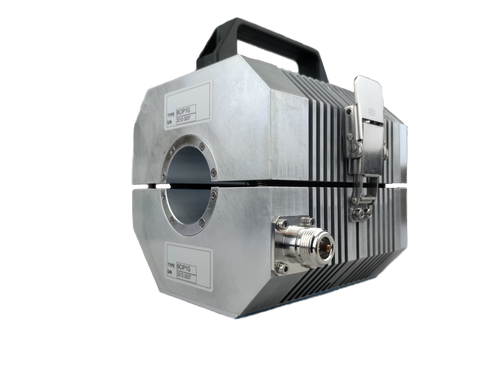
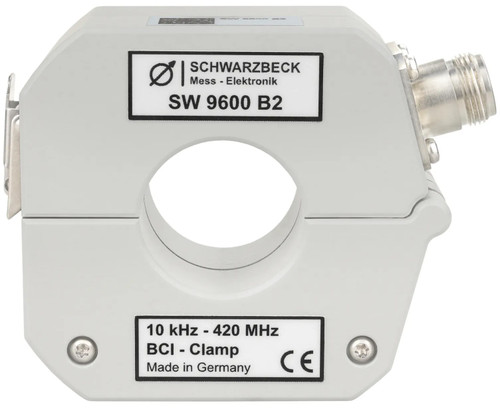
The Schwarzbeck SW 9600 B2 is a bulk current injection (BCI) clamp designed for conducted immunity testing in accordance with international EMC standards. It enables the injection of RF disturbances into cables without direct electrical contact, making it ideal for evaluating system immunity under real-world operating conditions.
Engineers use the SW 9600 B2 in EMC test setups to induce controlled currents onto wiring harnesses and cables, simulating electromagnetic interference typically encountered in automotive, aerospace, and industrial environments. Its stable performance and wide frequency capability ensure accurate and repeatable test results across a broad range of applications.
The clamp is commonly used alongside RF amplifiers, signal generators, and monitoring probes, allowing users to validate system robustness and identify potential susceptibility issues prior to formal compliance testing.
| Specifications: | |
|---|---|
| Usable Frequency Range | 1 kHz – 420 MHz |
| Connector (Female) | N |
| Transfer Impedance | typ. -20 dBΩ @ 8 kHz typ. 0 dBΩ @ 80 kHz typ. 15 dBΩ @ 1 MHz typ. 25 dBΩ (30–400 MHz) |
| Dimensions | 104 x 45 x 79 mm |
| Maximum Current | ~300 A (DC – 400 Hz) |
| Max. RF Input Power (CW) | 30 W |
| Transformation Ratio | 1:2 |
| Primary Inductance | typ. 3.7 µH @ 100 kHz |
| Max. Line Diameter | 31 mm |
| Aperture | 32 mm |
| Weight | ~600 g |
| Accessories | Calibration Fixture: CF 9651 |
At The EMC Shop, customers typically use the Schwarzbeck SW 9600 in bulk current injection (BCI) test setups to evaluate how cables and wiring harnesses respond to RF disturbances. Instead of making direct electrical contact, the clamp is positioned around the cable under test, allowing engineers to inject controlled RF currents while the system operates normally.
In automotive and industrial environments, this is commonly applied to test control modules, sensor lines, and power cables for susceptibility to electromagnetic interference. Engineers pair the SW 9600 with RF amplifiers and signal generators to simulate real-world noise conditions, helping them identify weak points in shielding, grounding, or cable routing.
Because of its non-intrusive design, customers can test complete systems without modifying the wiring, making it especially useful during product development and pre-compliance testing. This allows teams to resolve issues early, reduce redesign cycles, and move more confidently into formal EMC certification.