


Overview
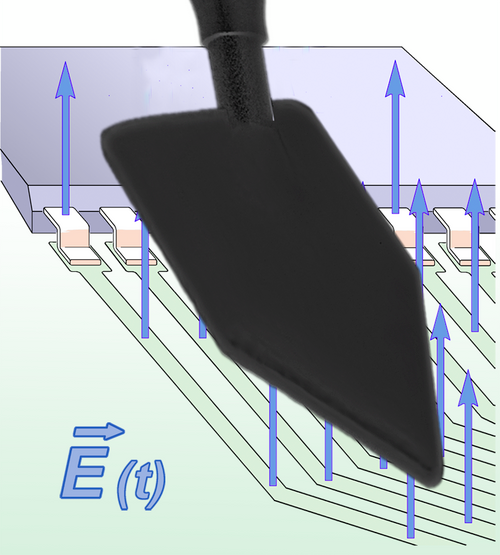
The RF-E near-field probe series allows users to access and detect electrical fields that are emitting unwanted electromagnetic energy from printed circuit boards and its integrated chips. The series allows users to different size probe heads to measure down to individual pins and up to bus structures, larger components or supply surfaces.
The Langer RF-E series consists of passive E-field near-field probes designed for measuring electrical fields on electronic assemblies [1, 2] . Most of these probes operate in the 30 MHz to 3 GHz frequency range, though specific models vary in their resolution and electrode size for different measurement tasks [3, 4, 5] .
Key Specifications by Model
| Model | Frequency Range | Electrode Size/Width | Resolution | Common Use Case |
|---|---|---|---|---|
| RF-E 02 | 30 MHz – 1.5 GHz | ~20 x 50 mm | Low | Large components, bus structures |
| RF-E 03 | 30 MHz – 3.0 GHz | ~4 x 4 mm | Medium | Small E-field sources, PCB tracks |
| RF-E 04 | 30 MHz – 3.0 GHz | ~5 x 5 mm | Medium | Clocked lines and ICs |
| RF-E 05 | 30 MHz – 3.0 GHz | ~0.5 mm width | ~0.6 mm | Precise location of IC pins & lines |
| RF-E 09 | 30 MHz – 3.0 GHz | ~10 x 10 mm | Medium | E-fields decoupled by ICs |
| RF-E 10 | 30 MHz – 3.0 GHz | ~0.2 mm width | ~0.2 mm | High-resolution for smallest pins |
General Characteristics
- Passive Operation: These probes are passive and do not require external power [13, 16] .
- Output Connector: Standard SMB (male) jack for connection to spectrum analyzers or oscilloscopes [4, 14] .
- Input Impedance: Designed for use with 50 Ω inputs [4, 15] . Note that they typically do not have an internal 50 Ω termination resistor [1, 17] .
- Shielding: Most models feature a current attenuating sheath and are electrically shielded to minimize influence from external fields or the user's hand [10, 11] .
- Applications: They are frequently used with Langer EMV-Technik scanners for automated 3D near-field mapping [1, 18] .


